
Let’s talk about European Residency Programmes.
Europe certainly has its downsides, but it still offers the strongest residency programmes with real upside.
Everyone Wants the European One
Ask anyone who's serious about building a portfolio of residencies which one they actually want, and the European one is always on the list.
Even that this residency is not the fastest one and not the cheapest one.
What makes a European residency stand out is that it solves several problems at once: the possibility of converting temporary residency into permanent, access to banking, real ownership of real estate assets, a genuine path to citizenship, and visa-free access across 29 countries.
For a lot of people, Europe is simply a great base. Which is exactly why it has become the hardest one to get. Programmes keep closing, timelines keep stretching, and the whole process gets more complicated every year.
The Most Accessible European Residency Programme
You might be surprised, but it’s Greece.
It isn’t the obvious answer, so let’s look at the details — because the Greek programme is open to almost everyone right now, and that window won’t stay open for long.
Most people looking at Greece are running on badly outdated information. Say “Greek economy” to most investors and something very specific happens behind their eyes: bailout negotiations, capital controls, queues at cash machines, unemployment near 28%.
All of that was real. It was also more than a decade ago.
So, Why Greece?
Here’s what happened while nobody was looking.
Fitch upgraded Greece’s rating to BBB in late 2025 and has affirmed it since with a stable outlook — comfortably investment grade, which for a country that was effectively locked out of debt markets a decade ago is not a small thing.
The economy grew 2.1% last year and is expected to do about the same this year, running ahead of the EU average.
Unemployment came in at 7.7% in January, the lowest since 2008. The budget runs a surplus. Public debt, which peaked near 200% of GDP, is on track for roughly 120% by 2030. Tourism cleared €20 billion.
This is full-membership Europe, not the periphery. Eurozone, Schengen, European Union. Your residence permit isn't a regional arrangement - it's Schengen mobility, and your asset is denominated in euros.
The holding costs are unusually light. Annual property tax runs around 0.1% — among the lowest in Western Europe.
The practical infrastructure works, too. English is widely spoken in Athens and throughout commercial life. Healthcare and international schooling are more than adequate for families who actually relocate. Geographically, Greece sits at the junction of Europe, the Middle East and North Africa, with strong US institutional ties - which matters if you are thinking about where you’d want to be standing rather than just where your paperwork lives.
The feature nobody makes enough noise about
There is no minimum stay. None.
Plenty of residency programmes quietly assume you'll show up - a week a year here, a visit every couple of years there. Greece asks for nothing. You can hold the permit for a decade and never spend a night in the country.
So why Greece is it still underrated?
Because everyone still thinks the economy is broken.
Say “Greece” and watch what happens. Someone brings up the debt. Someone else does the thing with their eyebrows. It’s automatic, and it’s been automatic since roughly 2012 - nobody has gone back to check, because why would you?
The perception never caught up. The country changed completely.
Who is Who Is Investing in Greece
The demand data suggests the gap is already closing.
In 2025, Greece approved 8,879 new Golden Visa permits - a 95% increase over the 4,535 approved in 2024.
That happened in the same year the government raised thresholds and banned short-term rentals on qualifying properties.
Demand doubled while the product got more expensive and more restricted. That is not how yield-seeking capital behaves.
Chinese buyers remain the largest single group, with 9,926 approvals in 2025, up 53.7%. But their share has fallen from historic peaks above 70% to 47.9% - not because Chinese demand collapsed, but because everyone else arrived.
Turkish approvals rose 160% to 3,291.
American approvals reached 578, up 49%.
Demand from across the Middle East grew at comparable rates.
And the American buyer isn't relocating. He is buying a door he may never walk through - and would prefer to already own if he ever needs it.
Greece’s Golden Visa is not being priced as an investment product. It is being priced as insurance with an asset attached.
What the Money Actually Buys
In 2024, Greece restructured the programme into three geographic zones for Golden Visa Investors
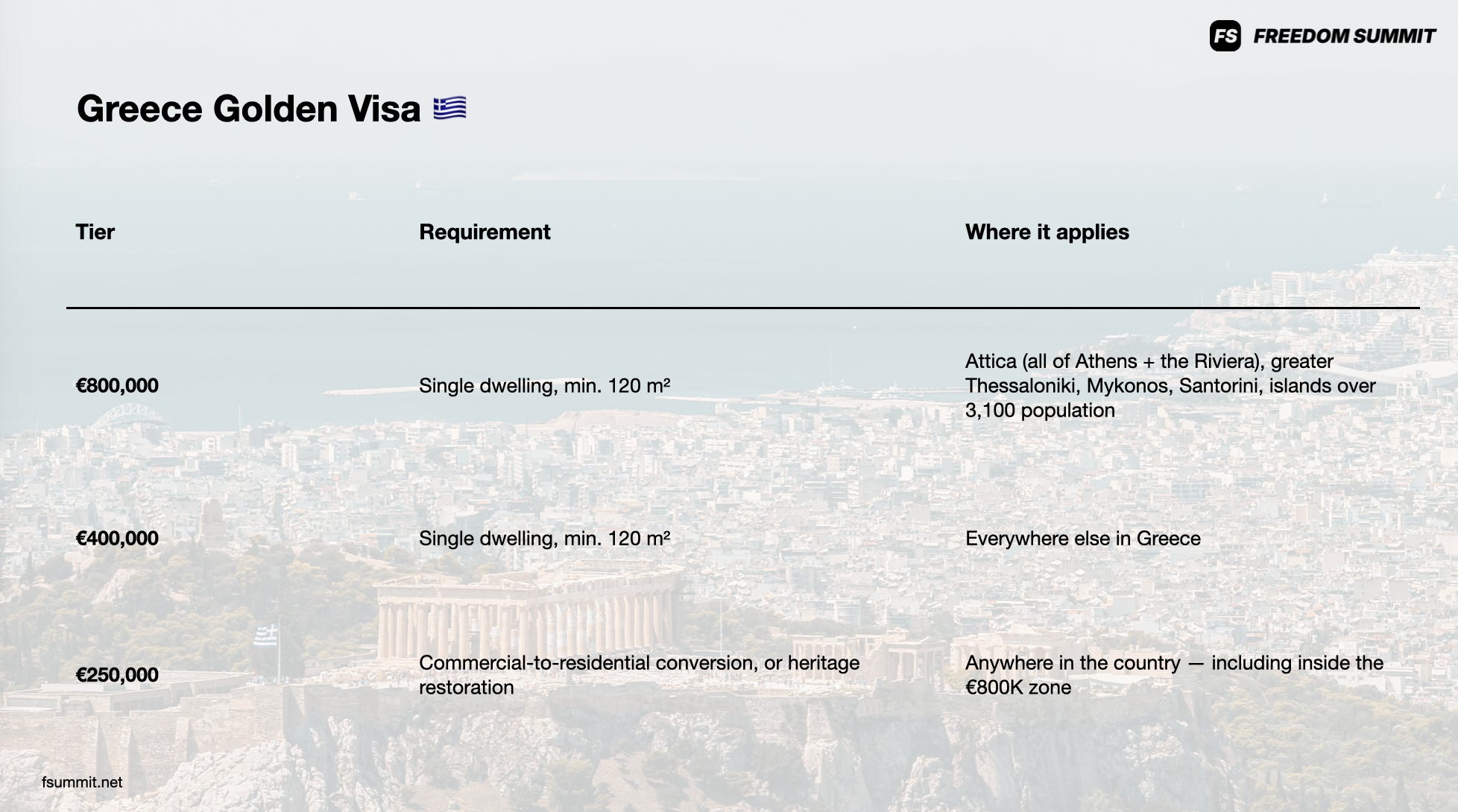
What comes with it: a five-year renewable permit tied to holding the asset, full Schengen mobility, family inclusion across three generations, zero minimum stay, and a citizenship path at seven years.
What doesn’t come with it: a passport. The seven-year route requires genuine tax residency of roughly 183 days a year, plus Greek at B1 level. If an advisor sells you Greece as a passport play, that tells you what kind of advisor he is.
And if the programme changes tomorrow - programmes do change - you still own the building.
The Market Underneath the Visa
A residence permit attached to a declining asset is a bad trade at any price. So what is actually happening to Greek property?
The recovery is complete, not pending. By Q3 2025, nationwide residential prices sat 7.14% above the 2008 pre-crisis peak in nominal terms, and 86% above the 2017 trough. Attica ran ahead at 12.5% above 2008, with the southern suburbs, central Athens and the northern districts posting gains of 20–30%.
This matters because the pitch you will still hear — “prices are below their 2008 highs, there’s a decade of catch-up left” — is now out of date in nominal terms. The catch-up trade has largely happened.
Adjusted for inflation, prices do remain below the old peak, and that is a legitimate argument for further appreciation. But it is a different, more modest argument than the one most brochures are still making, and you should know which one you are buying.
Forecasts for 2026 cluster around 4–7% national price growth — healthy, decelerating, and nothing like the 20%-plus prints of the recent cycle.
The honest summary: a normalising market with a solid macro floor, entered late in a strong cycle rather than early in a cheap one. Still a reasonable place to park euro capital. Not a moonshot, and anyone presenting it as one is selling.
The Four Things That Need To Know
First, some context on the cheapest tier.
Athens has a housing shortage, and the government wants derelict commercial and industrial stock converted into livable apartments, rather than foreign capital bidding up existing residential inventory against Greek families.
So it priced the conversion route at a third of the prime threshold — and left it available inside Attica.
A converted asset in Athens qualifies at €250,000. The finished apartment next door requires €800,000.
With that in mind, here are the four things to understand before you commit.
Short-term rental is banned, and enforced. Golden Visa properties cannot be listed on Airbnb or Booking.com. The penalty is permit revocation plus a €50,000 fine. Any model built on hot nightly rates is dead. For a ten-year holder this is arguably stabilising - it forces the asset into long-term leasing, which is duller and easier to exit. But the upside was regulated away, and nobody should pretend otherwise.
Guaranteed yield is a product, not a market rate. Operators advertise around 4% net. Open-market Athens residential yields run closer to 2.5–3%. The spread is the operator absorbing vacancy and management risk and pricing it in.
The turnkey premium is real. Visa-qualifying” packages routinely trade at a markup over comparable non-packaged stock, with reported ranges running from 15% to 40%. Commission an independent valuation from someone the seller doesn’t pay. Resistance to that request is itself the answer.
Processing is congested. The 2024 rule change produced a significant administrative backlog, with roughly 80% of pending cases concentrated in Attica. Build timeline risk into your plan rather than trusting the marketing timeline.
Who Is Behind This ?
Here’s the thing that took me a while to see clearly.
The question to ask isn’t whether Greece is a good programme. Greece is a good programme.
The question is: who exactly is going to be on the other end of this, and are they any good?
Short-term rental is illegal, so your income depends entirely on somebody running long-term leases competently in a city you don’t live in. Yield is compressed, so the gap between 2.5% and 4% isn’t the market - it’s execution.
The €250,000 tier needs the conversion finished before you file, which means you structurally can’t use a broker. You need someone who actually builds things.
And then there’s the part nobody says out loud: you’re buying a building you’ll see in photographs, in a language you don’t read, from people you met on a video call.
That’s where the real risk in this trade lives. Not in Greece. Not in the euro. In the counterparty.
Which brings me to LUX&EASY.
Vasilis Leivadas spoke at the Freedom Business Summit about Greek Golden Visa options.
LUX&EASY develop the buildings, manage the properties and run the hospitality operations themselves, all under one roof.
When the same company builds the asset, furnishes it, finds the tenant and operates it, the conversion timeline and the tenant pipeline and the yield model all sit inside a single P&L.
Nobody gets to blame the other guy, because there is no other guy. For an owner sitting 5,000 kilometres away, that one fact is more or less the whole product.
They took us through several live projects, and what struck me is that they solve different problems rather than sitting at different price points.
Serenity Residences, Piraeus — serviced apartments run on a hospitality model with a guaranteed yield structure.
Effectively a real estate/hotel hybrid, built for the investor who wants income and zero operational contact. One thing worth knowing: Piraeus has been among the fastest-appreciating submarkets in the country, running near 28.9% a year through the recent cycle. That cuts both ways. Strong recent appreciation is exactly what compresses the returns still ahead of you.
AFEA Residence, Aegina — lower density, coastal, second-home in character. This is the lifestyle-hedge allocation: the one you'd actually live in if the door ever needed opening. Weakest of the two on pure yield, strongest on the thing you'd want it for.

The whole package is deliberately hands-off - furnishing, management, maintenance, all of it included - which is precisely what someone who has no intention of moving to Greece actually needs.
Then there's the institutional scaffolding: strategic alliances with Hilton Garden Inn Athens Syggrou Avenue, Hilton Garden Inn Chania City and ÉRA Hotel Heraklion, Tapestry Collection by Hilton, alongside Big Four audit relationships, a credit rating and more than 120 projects delivered.
That exists for one reason, which is that you can't run reference checks from another continent.
Ask for all of it anyway. Any operator worth €400,000 of your money hands over the documentation the first time you ask. The ones who get evasive have just answered a different question, and saved you a lot of time.
If Greece is on your radar
We’re connecting a limited number of Summit attendees directly with the LUX&EASY development team - not a brochure, not a webinar, a conversation with the people who actually build and operate the assets.
Before that call we’ll ask you three things: your target tier, your timeline, and whether you’re solving for residency, yield, or an exit option you hope never to use. If you don’t know yet, that’s what the call is for.